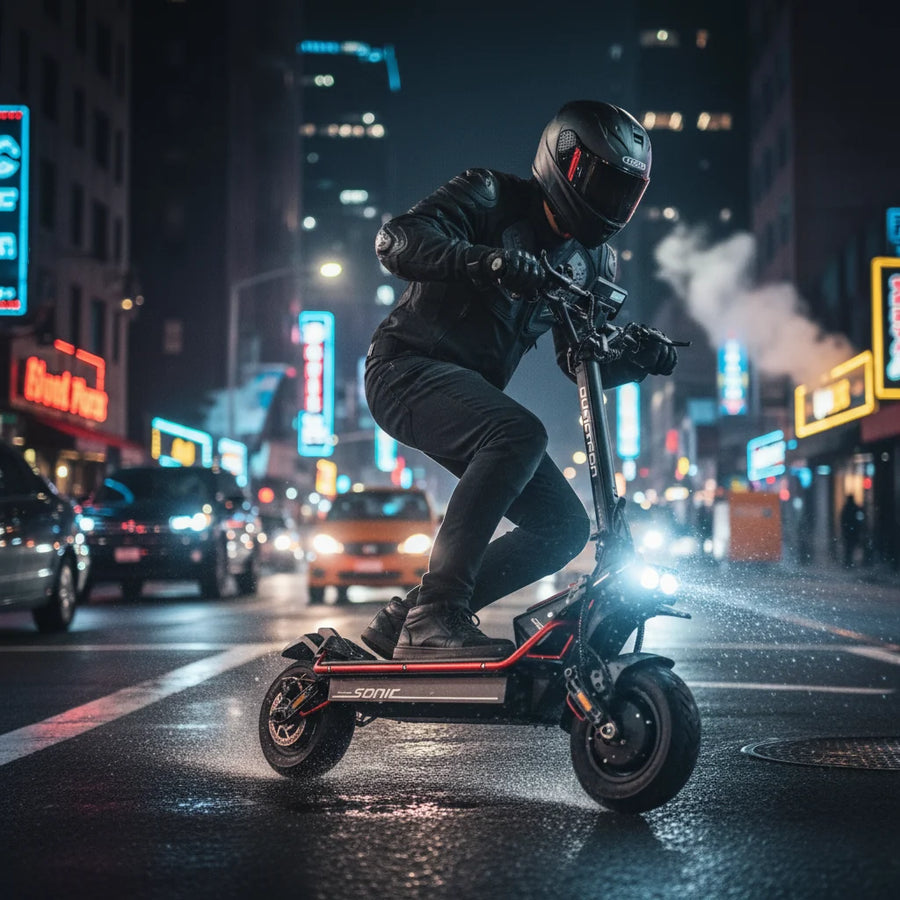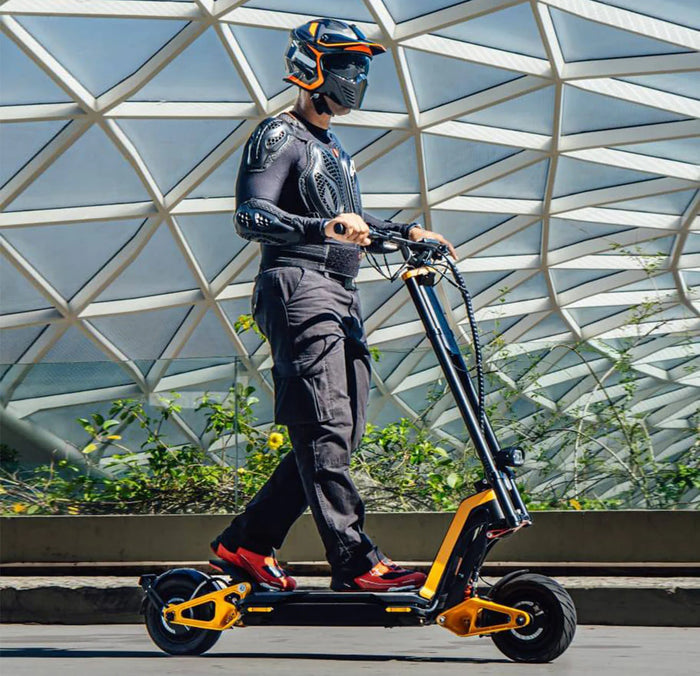
Winter riding across Dublin and the broader Irish landscape is not merely a question of wearing heavier gloves or wiping down a frame. Between October and March, maritime North Atlantic depressions subject light electric vehicles to a relentless combination of sub-8°C ambient air, saturated humidity, corrosive de-icing brine, and slick road surfaces. These environmental stresses systematically attack four distinct subsystems: electrical enclosure seals, lithium-ion battery chemistry, tyre tread rubber viscoelasticity, and braking interface friction. This comprehensive 3,000+ word engineering guide details the exact physics behind winter degradation, dispels dangerous waterproofing myths, explains cold lithium electrochemistry, and establishes strict workshop protocols to keep electric scooters and e-bikes operating safely through the Irish winter.
1. Ingress Protection (IP Ratings) — The Physics of Water Penetration
The word "waterproof" has become one of the most misused terms in commercial micromobility marketing. In our Capel Street diagnostic workshop, water ingress accounts for more than 45% of all non-puncture component failures between November and February. To understand why electric vehicles fail in wet weather, riders must understand the precise engineering boundaries defined by the International Electrotechnical Commission standard IEC 60529, commonly known as the Ingress Protection (IP) code.
Deconstructing IEC 60529: What the Laboratory Numbers Mean
An IP rating consists of two characteristic numerals. The first digit (0 to 6) indicates resistance against solid foreign objects and dust. The second digit (0 to 9) designates resistance against ingress of liquid water. When a specification sheet reads IPX5 or IPX6, the "X" indicates that the manufacturer did not submit the device for formal dust-ingress testing, focusing entirely on liquid protection.
Crucially, laboratory ingress tests are conducted using clean, room-temperature fresh water directed onto stationary components under controlled durations. They do not simulate road grit, airborne salt spray, tyre-flung centrifugal water pressure, or the dynamic flexing of a structural chassis under rider load:
- IPX4 (Splash Resistance): Tested with an oscillating spray bar delivering 10 litres per minute across a 180-degree radius at 80 to 100 kPa for 10 minutes. IPX4 provides nominal protection against light, ambient drizzle. It offers zero resistance against pressurized water thrown from a spinning 10-inch wheel directly into a deck seam.
- IPX5 (Low-Pressure Water Jet): Tested using a 6.3 mm nozzle delivering 12.5 litres per minute at 30 kPa at a distance of 3 metres for 3 minutes. This represents the baseline minimum for moderate rain riding, but remains vulnerable to sustained wheel spray and standing puddle wash.
- IPX6 (Powerful Water Jet): Tested using a 12.5 mm nozzle delivering an intense 100 litres per minute at a pressure of 100 kPa from a distance of 3 metres for 3 minutes. This level resists heavy sea spray, torrential rainfall, and dynamic surface wake thrown by preceding vehicular traffic.
- IPX7 / IPX8 (Temporary to Continuous Immersion): Tested by submerging the enclosure in water up to 1 metre deep for 30 minutes. No commercial electric scooter or standard e-bike is legitimately submersible. Claiming full IPX7 capability on a vehicle with rotating axle passages, cooling heat sinks, and removable charging ports is an engineering falsehood.
| Rating | Test Method | Flow Rate & Pressure | Real Dublin Commute Viability | Vulnerable Failure Points |
|---|---|---|---|---|
| IPX4 | Oscillating spray bar, 10 min | 10 L/min @ 80–100 kPa | Fair-weather only; high failure risk in rain | Deck perimeter seams, throttle housing, cable entry grommets |
| IPX5 | 6.3 mm nozzle @ 3 metres | 12.5 L/min @ 30 kPa | Light to moderate rain; puddles must be avoided | Motor axle bearings, charge port door, display push-buttons |
| IPX6 (Factory) | 12.5 mm nozzle @ 3 metres | 100 L/min @ 100 kPa | Heavy rain and wet roads; no standing water entry | Aged silicone seals, split-rim valve holes, thermal vacuuming |
| IPX6 Stage 2 (Lifty Labs) | Triple-barrier Japanese polysiloxane chemical seal | 100 L/min dynamic spray + internal PCB potting | Engineered for continuous Irish winter commuting | None under spray; submersion strictly excluded |
| IPX7 / Submersible | Static immersion to 1.0 m depth | Hydrostatic pressure @ 10 kPa | Unattainable in road vehicles without hermetic motors | Axle lip seals fail under vacuum contraction |

The Thermal Contraction Vacuum: Why Submersion Destroys Motors
The most insidious water ingress mechanism observed in our workshop is not pressure pushing water in, but atmospheric vacuum drawing water in. When you commute on an e-scooter or hub-motor e-bike, the motor coils, controller MOSFETs, and battery cells generate significant thermal energy. Internal motor cavity temperatures routinely reach 45°C to 60°C. According to the Ideal Gas Law ($PV = nRT$), the air sealed inside the warm hub motor expands.
When a rider rolls through a deep cold puddle (water temperature 4°C to 7°C on Dublin quays), the aluminum motor housing undergoes rapid thermal quenching. The internal air contracts instantly. Because the motor cannot replenish that contracted air volume instantly, a negative pressure differential of 10 to 15 kPa develops across the axle seals. This vacuum pulls dirty, gritty puddle water past the rubber lip seals and directly into the copper stator windings and neodymium magnets. Within 48 hours, electrolytic oxidation begins, causing hall-sensor short circuits, magnet delamination, and seized bearings.
The 6 Critical Capillary Ingress Points
Water does not enter through solid aluminum; it exploits microscopic tolerances, capillary attraction, and material interfaces:
Rubber grommets where the main motor harness, brake lines, and throttle wiring enter the chassis deck degrade and harden in cold weather. Capillary action channels road wash along the corrugated cable sheathing straight into the battery compartment.
Rotating shafts require low-friction clearance. Standard dust seals (2RS / ZZ shields) resist dry dirt, but fail when submerged under standing water, allowing grit and moisture to enter the bearing races.
Handlebar-mounted LCD displays, trigger throttles, and mode buttons are exposed to oncoming wind-driven rain. Moisture penetrates through button bezels, condensing on the underside of the screen cover and shorting the 5V communication bus.
Scooters utilizing two-piece split rims allow water to seep between the aluminum halves, trapping moisture against the inner tube. This initiates internal rim corrosion that slices tyre beads.
Chassis plates secured with countersunk steel bolts flex over Dublin potholes. Gaskets compress unevenly, creating microscopic gaps where water thrown by the front tyre is forced into the lower battery cradle.
Rubber port covers that do not seat with an airtight seal allow water droplets to sit across the 48V–72V charging pins. Connecting a live charger to a damp port creates an instantaneous high-amperage arc, destroying the pins and blowing the internal charge fuse.
No chemical sealant or aftermarket service can transform an electric scooter into a boat. Lifty Labs weatherproofing is strictly capped at Stage 2 IPX6 Japanese Super Sealant (€199). We never claim IPX7, IPX8, or 100% waterproof protection. Our service is engineered to withstand torrential rain, high-volume road spray, and wet asphalt, but standing water above axle height must always be avoided.
The Lifty Labs Stage 2 IPX6 Japanese Super Sealant Protocol (€199)
To deliver true cold-climate reliability, Lifty Labs developed our proprietary Stage 2 IPX6 sealing service at our Capel Street workshop. This is a multi-tier chemical and mechanical insulation procedure executed over 2 to 3 days:
- Tier 1 — PCB Conformal Potting: The electronic speed controller (ESC), battery management system (BMS) telemetry harness, and display circuit boards are completely removed and coated with high-dielectric silicone-modified polyurethane conformal insulation. This ensures that even if atmospheric condensation forms inside the deck, circuit traces cannot bridge or short.
- Tier 2 — High-Modulus Polysiloxane Gasket Engineering: Factory foam and paper gaskets are stripped. All mating surfaces are degreased with pure isopropyl alcohol, prepped with adhesion promoter, and sealed using imported Japanese neutral-cure polysiloxane elastomeric sealant. This compound maintains elongation elasticity down to -25°C without hardening, cracking, or shrinking.
- Tier 3 — Axle and Cable Gland Barrier Reinforcement: Motor axle exits and chassis cable glands are encapsulated with dual-lip hydrophobic silicone collars. Dielectric silicone grease is packed into all electrical multi-pin connectors to permanently displace oxygen and moisture.
All repair and weatherproofing intake is managed strictly via in-person customer drop-off at 157 Capel Street, Dublin 1. We do not accept postal or courier send-ins to prevent handling damage to lithium traction systems.

2. Cold-Weather Lithium Battery Electrochemistry
Riders frequently visit our workshop in December and January convinced their battery is dying because their range has suddenly collapsed by 35%. In 90% of cases, the battery cells are structurally intact; they are simply trapped by the fundamental laws of chemical kinetics. Understanding how temperature dictates lithium ion movement is vital for preserving pack longevity and preventing catastrophic safety hazards.
Electrolyte Viscosity & The Arrhenius Equation
Traction battery packs in high-end electric scooters and e-bikes rely predominantly on cylindrical lithium-ion cells with NMC (Nickel Manganese Cobalt) or prismatic LFP (Lithium Iron Phosphate) chemistry. Inside each cell, lithium ions ($Li^+$) shuttle between the cathode and graphite anode through a liquid organic carbonate electrolyte (typically a mixture of ethylene carbonate and dimethyl carbonate containing dissolved lithium hexafluorophosphate, $LiPF_6$).
According to the Arrhenius equation, the rate constant ($k$) of a chemical reaction is exponentially dependent on absolute temperature ($T$):
The Arrhenius Law of Reaction Kinetics
k = A · e^(-E_a / (R · T))
Where E_a is the activation energy, R is the universal gas constant, and T is absolute temperature in Kelvin. As ambient temperature drops from a summer baseline of 20°C (293 K) to a Dublin winter morning of 2°C (275 K), the thermal kinetic energy within the cell plummets. The liquid electrolyte thickens, increasing its dynamic viscosity by over 200%. As a consequence, ionic conductivity drops dramatically and internal charge-transfer resistance (R_ct) spikes.
Voltage Sag Dynamics: Why Displays "Lie" in Winter
Internal resistance ($R_{internal}$) governs terminal voltage under load according to Ohm's Law:
V_{terminal} = V_{open\_circuit} - (I_{draw} × R_{internal})
When you demand high current ($I$) to accelerate or climb a hill, the increased internal resistance causes terminal voltage to sag precipitously. A 52V battery operating at 20°C might drop 2.5V under a 25A load. At 3°C, that exact same pack may sag by 6.5V to 8.0V under identical load.
This massive voltage sag triggers the Battery Management System's (BMS) low-voltage cutoff threshold prematurely. Your battery may still possess 60% chemical energy, but because terminal voltage falls below the safety floor under load, the BMS abruptly shuts off power to protect the cells. When you release the throttle or let the vehicle rest, the voltage slowly rebounds, giving the illusion that your battery capacity is wildly fluctuating.
| Pack Core Temp | Relative Internal Resistance | Usable Wh Output vs Nominal | Voltage Sag under 20A Load | Permissible Charging Status |
|---|---|---|---|---|
| 20°C to 25°C | 1.0× (Baseline) | 100% (Full Rated Wh) | ~2.0V – 2.8V | Optimal (Full 0.5C–1.0C charge rate) |
| 10°C to 15°C | 1.25× (+25%) | 90% – 93% | ~3.2V – 4.0V | Safe (Normal charging) |
| 5°C to 9°C | 1.6× (+60%) | 75% – 82% | ~4.5V – 5.5V | Reduced rate recommended (0.2C–0.3C) |
| 0°C to 4°C | 2.2× (+120%) | 60% – 70% | ~6.0V – 8.0V | Hazardous; restrict to ≤0.1C trickle |
| Sub-Zero (<0°C) | 3.0×+ (+200%) | <50% (High Cutout Risk) | >9.0V (Instant BMS Cut) | STRICTLY FORBIDDEN (Lithium Plating) |
The Deadly Danger of Sub-Zero Charging: Anodic Lithium Plating
While riding in cold weather temporarily reduces available range, charging a cold battery causes permanent, irreversible structural destruction. This is the single most critical battery safety rule riders must master:
During charging, lithium ions travel from the cathode to the anode and must intercalate (insert themselves) between the graphene layers of the graphite matrix. When the cell core is below 5°C, and especially below 0°C, the rate of intercalation becomes slower than the electrical current arriving at the electrode surface.
Unable to enter the graphite lattice, the lithium ions undergo electrochemical reduction directly on the anode surface, forming solid metallic lithium plating. Over successive cold charge cycles, these metallic deposits grow into microscopic, needle-like structures called dendrites. Dendrites eventually puncture the thin polymer separator membrane between the positive and negative electrodes, creating an internal micro-short circuit. This leads to irreversible capacity destruction, elevated self-discharge rates, and in severe cases, catastrophic thermal runaway.
The Lifty Labs 90-Minute Thermal Equilibrium Rule
Never plug your charger into a vehicle immediately after a cold winter ride.
Even if your living room is 20°C, a dense 1,000Wh battery pack insulated inside an aluminum chassis acts as a thermal heat sink; its internal core remains cold for hours. Bring the vehicle or removable battery indoors and allow a mandatory 90 to 120 minutes for the cell core to reach thermal equilibrium before connecting the charger.
Winter Storage Protocol: Managing State of Charge (SoC)
If you store your electric bike or scooter during the deepest winter months, follow the strict chemical preservation protocol established by our workshop team:
- Target 50% to 70% SoC: Never store a battery fully charged at 100% (4.20V/cell) or depleted at 0% (3.00V/cell). High voltage combined with prolonged storage stresses the cathode structure and accelerates electrolyte oxidation. Storing at 0% allows parasitic BMS drain to pull individual cell voltages below 2.5V, dissolving the copper current collectors and bricking the pack permanently.
- Store at 10°C to 18°C: Store the pack in a dry, insulated utility room or indoor closet. Never leave a battery inside a damp, unheated outdoor shed or metal garage where temperature swings create condensation.
- Quarterly Health Check: Check the pack voltage once every 45 to 60 days. If the state of charge drops below 40%, top it up to 60% and disconnect the charger.
Workshop Battery Policy: Lifty Labs provides professional diagnostic load analysis and OEM replacement traction packs. We strictly do not perform battery cell rebuilding, repacking, or cell modification, adhering purely to factory safety specifications.

3. Cold-Asphalt Tyre Mechanics & Contact Patch Physics
Traction is the sole link between your vehicle and the street. In winter, Dublin asphalt transforms from a predictable surface into a low-friction obstacle course. The primary culprit is not merely surface water, but the chemical hardening of rubber polymers under low ambient temperatures.
The Glass Transition Temperature ($T_g$) of Tread Rubber
All tyre compounds are manufactured from elastomeric polymer matrices blended with carbon black, silica, and vulcanizing agents. Rubber achieves grip through two physical phenomena: adhesion (molecular bonding between rubber and surface asperities) and hysteresis (energy loss as the rubber deforms over road texture).
Every rubber compound exhibits a specific Glass Transition Temperature ($T_g$). Above its $T_g$, the polymer chains are flexible, elastic, and capable of micro-deforming around aggregate stones on the tarmac. When ambient and road surface temperatures drop below 7°C, standard commuter rubber compounds approach their glass transition zone. The polymer chains stiffen, elasticity drops by over 50%, and the tyre effectively transforms into hard, glassy plastic. As a result, the tyre can no longer conform to road texture, and dynamic friction plummets.
Contact Patch Reality & The Pressure Formula
Consider the physical footprint of light electric vehicles:
- 10-inch Electric Scooter Tyre: The contact patch with the road measures approximately 12 to 18 square centimetres—roughly the footprint of a standard credit card.
- 28-inch (700c) Commuter E-Bike Tyre: A 700x40c tyre provides an elliptical contact patch of approximately 22 to 28 square centimetres.
Tyre pressure fluctuates directly with ambient temperature according to Charles's Law and Gay-Lussac's Law. In practical workshop terms:
For every 10°C drop in ambient temperature, pneumatic tyre pressure decreases by approximately 1.5 to 2.2 PSI. A tyre inflated to 45 PSI inside an 18°C hallway drops to roughly 41.5 PSI after 30 minutes in 2°C outdoor air.
Lifty Labs Winter Pressure Calibration: While under-inflation risks pinch flats and rim strikes on Dublin potholes, excessive tyre pressure reduces the contact patch to a dangerously narrow strip. In wet winter conditions, we recommend running pneumatic tyres 2 to 3 PSI below your normal summer baseline (e.g., reducing from 45 PSI down to 42–43 PSI on a 10x2.5-inch scooter tyre). This slight reduction allows the tyre casing to flex, expanding the contact patch by up to 15% and increasing micro-mechanical grip on cold aggregate without compromising pinch-flat protection.
Pneumatic vs Tubeless with Sealant vs Solid Tyres
Riders frequently ask whether converting to solid puncture-proof tyres makes sense for winter commuting. From an engineering and safety standpoint, our workshop verdict is clear:
The Engineering Case Against Solid Tyres in Winter
Solid rubber and honeycomb tyres lack an air chamber, which means they cannot deform across micro-asperities. On cold, damp Dublin asphalt, a solid tyre's dynamic friction coefficient is up to 60% lower than that of a quality pneumatic tyre. When striking wet painted cycle lines, metal utility covers, or Luas tram rails, solid tyres break traction instantaneously without progressive slip warning.
Lifty Labs strictly advises against solid tyres for winter riding. The optimal winter setup is tubeless pneumatic tyres injected with glycol-based anti-freeze sealant, or premium reinforced pneumatic tyres paired with thick butyl inner tubes.
Dublin Surface Friction Coefficients ($\mu$) & Stopping Distance Physics
Braking distance is governed by the kinematic formula:
d = v^2 / (2 × μ × g)
Where v is velocity (5.56 m/s at 20 km/h), g is gravitational acceleration (9.81 m/s²), and μ is the coefficient of dynamic friction between tyre and surface. The table below illustrates the staggering variation in friction across Dublin city infrastructure:
| Road Surface Material | Friction Coeff (μ) — Dry 20°C | Friction Coeff (μ) — Wet 4°C | Stopping Distance @ 20 km/h (Pneumatic) | Stopping Distance @ 20 km/h (Solid Tyre) |
|---|---|---|---|---|
| Clean Dublin Tarmac (Asphalt) | 0.75 – 0.85 | 0.45 – 0.55 | ~3.2 metres | ~5.8 metres |
| Thermoplastic Road Paint (Cycle Lanes) | 0.65 – 0.70 | 0.25 – 0.30 | ~5.6 metres | ~9.2 metres |
| Wet Steel Utility Trench Plates | 0.55 – 0.60 | 0.15 – 0.18 | ~9.4 metres | ~14.5 metres |
| Luas Steel Tram Tracks | 0.50 – 0.55 | 0.12 – 0.15 | ~11.5 metres | ~17.2 metres |
| Wet Decomposing Autumn Leaf Mulch | 0.40 – 0.45 | 0.10 – 0.14 | ~12.8 metres | ~19.0 metres |
| Black Ice / Frozen Surface Glaze | 0.15 – 0.20 | 0.05 – 0.08 | ~21.0+ metres | Loss of Control |

4. Braking Systems, Hydraulics & Regenerative Dynamics in Wet Weather
Stopping power in wet conditions involves complex friction mechanics between disc rotors, pad friction materials, and hydraulic actuation fluids.
The Water Film Shear Lag
When disc brakes are dry, squeezing the brake lever results in immediate mechanical deceleration. In pouring rain, a thin hydrodynamic boundary layer of water coats the surface of the stainless steel rotor. During the first 0.3 to 0.5 seconds of lever pull, the brake pad cannot make direct contact with the steel; it must first shear and boil away this micro-film of water through friction heat.
This phenomenon causes an unnerving "lever lag" where the vehicle continues rolling forward without substantial slowing for the first meter of braking. Rotor slotting and cross-drilling help channel water away, but riders must anticipate this delay by dragging their brakes lightly every 200 meters in heavy rain to keep the rotor and pad swept dry.
Brake Pad Compounds: Organic vs Semi-Metallic vs Sintered
Brake pad selection determines whether your brakes survive an Irish winter:
- Organic / Resin Pads: Formulated with organic fibres bound by resin. They deliver whisper-quiet operation and immediate bite in dry summer weather. However, in wet winter conditions, the combination of road grit, sand, and standing water acts as liquid sandpaper; organic pads can disintegrate completely in as little as 350 to 500 km of daily commuting.
- Semi-Metallic Pads: A balanced hybrid incorporating steel and copper fibres. They provide decent thermal stability and moderate resistance to gritty wet abrasion.
- Sintered Full-Metallic Pads: Formulated from copper and metallic powders fused under extreme heat and pressure. Sintered pads are impervious to water absorption, withstand abrasive road grit without premature wear, and maintain consistent friction coefficients when wet. They produce occasional squeal in damp weather, but for winter reliability on heavy e-scooters and pedelecs, sintered metallic pads are the undisputed engineering choice.
Hydraulic Fluid Viscosity & Piston Sluggishness
Braking systems utilize either Mineral Oil (e.g. Shimano, Magura, Nutt) or synthetic DOT 4 / 5.1 fluid. While mineral oil is non-corrosive to paint and environmentally safe, its kinematic viscosity increases noticeably at temperatures below 5°C. As the oil thickens, master cylinder piston return springs push back more sluggishly, leading to a firmer, slower-returning lever. If your hydraulic brakes have absorbed moisture or have not been bled in over 12 months, trapped water droplets inside the caliper will expand and freeze near 0°C, causing total hydraulic lockup.
The Lethal Trap of Aggressive Regenerative Braking (E-ABS)
Performance electric scooters feature regenerative electronic braking modulated via the motor controller. In dry summer conditions, regen braking helps conserve brake pads and reclaims minor energy back into the battery pack.
In wet winter conditions, aggressive regen is a major hazard. Unlike modern automotive anti-lock braking systems with hall-wheel speed sensors sampling at 100 Hz, consumer scooter E-ABS systems cannot modulate slip thresholds dynamically. When an aggressive electronic brake (Level 3 to Level 5 in scooter P-settings) engages on cold, wet asphalt, the motor locks the rear drive wheel instantaneously. On a two-wheeled machine, an instant rear-wheel lockup results in uncontrolled fishtailing and a violent low-side crash within milliseconds.
Enter your scooter's display configuration menu and adjust the Electronic Braking / Regen Strength (usually P9 or PA depending on display model) down to Level 1 or 0. Rely purely on progressive mechanical or hydraulic disc brakes where your hands can modulate pad pressure with fine tactile feedback.

5. Chemical Attack — Road Salt, De-Icing Brine & Galvanic Corrosion
Dublin City Council and road maintenance authorities deploy thousands of tonnes of sodium chloride rock salt and liquid calcium/magnesium chloride brine across primary transport arteries to combat frost. While effective for motor vehicles, this chemical cocktail is lethal to light electric vehicles.
The Mechanism of Galvanic Coupling
When dissimilar metals are in direct contact in the presence of an electrolyte (saltwater brine), an electrochemical galvanic cell is established. Light electric vehicles are constructed from diverse metallic elements:
- Chassis frames fabricated from 6061-T6 or 7005 aluminum alloy.
- Fasteners, axle spindles, and brake rotor bolts made of Grade 8.8 / 10.9 zinc-plated or stainless steel.
- Wheel spoke nipples made of brass.
- Internal wiring conductors made of copper.
Aluminum has a low standard electrode potential (-1.66V), making it anodic compared to steel (-0.44V) and copper (+0.34V). When conductive saltwater enters screw threads, axle collars, or brake caliper mounts, the aluminum sacrificially corrodes to protect the steel bolt. This results in seized fasteners, cracked axle mounts, and powdering white aluminum oxide bloom that compromises structural integrity.
The Lifty Labs 5-Minute De-Salting Protocol
Washing your vehicle incorrectly after a salty commute can cause more damage than the salt itself. Follow our strict workshop procedure:
Never direct a garden hose nozzle or commercial jet wash at an e-scooter or e-bike. High-pressure water easily penetrates cartridge bearing seals, display housings, and motor axle grommets, pushing grit directly into the bearings.
Use a garden pump-sprayer set to mist, or a bucket of lukewarm fresh water and a clean microfibre sponge. Gently rinse road salt and grit off the frame, swingarms, and mudguards without spraying water directly into wheel hubs or deck cable entries.
Thoroughly dry all surfaces with a clean microfibre towel. If you possess a compressed air blower or leaf blower, blow moisture out of fastener sockets, folding latches, and kickstand pivots.
Apply a light mist of water-dispersing protective fluid (such as Muc-Off MO-94, ACF-50, or WD-40 Specialist Corrosion Inhibitor) onto exposed metal linkages, suspension springs, and fastener heads. Mask your brake rotors and pads with a clean rag before spraying; even trace overspray will permanently ruin your brake pads.
6. Dublin Urban Route Tactics & Tram Track Engineering
Safe winter riding requires deep awareness of Dublin's unique physical urban topography. Certain micro-environments demand specialized riding techniques:
The Luas Tram Track Geometry: The 90-Degree Rule
The Luas Red and Green line tracks running through Capel Street, Abbey Street, O'Connell Street, College Green, and Marlborough Street represent the single highest crash hazard for electric scooters and bikes in Dublin:
- Track Rail Dimension: The recessed groove of a grooved tram rail measures approximately 33 to 36 mm wide and 35 mm deep.
- Tyre Entrapment Risk: A standard electric scooter tyre measures 50 to 65 mm wide. If crossed at an acute angle (less than 45 degrees), the tyre slips off the polished steel rail head and drops into the channel. The vertical steel rail lip wedges the tyre, imparting an instantaneous rotational moment on the steering column that throws the rider over the handlebars.
- The Polished Steel Friction Drop: As shown in our friction telemetry, wet steel has a friction coefficient of barely μ=0.12. Squeezing brakes or cornering while crossing a rail causes instant front-wheel washout.
Always cross Luas tracks as close to a perpendicular 90-degree angle as traffic allows. Never apply brakes, accelerate, or lean the vehicle while rolling over the steel rail. Keep the vehicle completely upright, absorb shock through bent knees, and coast across.
The River Liffey Quays & Docklands Hazards
Commuting along the North and South Quays presents severe winter drainage challenges. The continuous flow of Dublin Bus traffic pushes standing water into deep drainage depressions beside the kerb. These standing ponds conceal severe potholes, loose granite setts, and sunken utility access covers. Always claim the primary lane position when safe, riding at least 1 metre away from the kerb to avoid standing drainage ponds and dirty vehicle spray.
7. The Master Scrollable Workshop Maintenance Schedule
Preventive maintenance preserves resale value, extends component life, and prevents dangerous roadside breakdowns. Our technicians recommend dividing maintenance into four structured intervals:
| Frequency | Inspection Checkpoint | Target Engineering Specification | Corrective Workshop Action |
|---|---|---|---|
| Pre-Ride (Daily 60s) | Tyre pressure & bead check | 42–44 PSI (scooter) / 55–65 PSI (e-bike) | Inflate with track pump; inspect for embedded flint or glass |
| Pre-Ride (Daily 60s) | Brake lever throw & bite point | Bite engaged within first 25% of lever travel | Inspect pad wear; adjust barrel or top up mineral oil |
| Pre-Ride (Daily 60s) | Folding latch & stem lock collar | Zero free play / positive mechanical lock | Torque safety collar; never ride with loose stem latch |
| Pre-Ride (Daily 60s) | Front & rear lighting check | Full beam output; lenses free of dirt film | Wipe lenses; charge external auxiliary lights |
| Weekly (Post-Ride) | Freshwater de-salting & rinse | Low pressure fresh water rinse | Sponge wash frame; microfibre dry all electrical seams |
| Weekly (Post-Ride) | Suspension pivot & latch lube | Hydrophobic PTFE or silicone film | Lube folding hinges and suspension arms; shield brake rotors |
| Weekly (Post-Ride) | Brake disc degreasing | Pure isopropyl alcohol wipe | Remove oil residue and road film from rotor faces |
| Monthly (Deep Audit) | Fastener torque verification | M6: 8–10 Nm | M8: 20–25 Nm | Axle: 40–50 Nm | Audit with calibrated torque wrench; reapply blue Loctite 243 |
| Monthly (Deep Audit) | Brake pad friction thickness | Minimum 1.0 mm friction material remaining | Replace worn pads with sintered metallic compound |
| Monthly (Deep Audit) | Wheel bearing play & smoothness | Zero axial play; smooth silent spin | Inspect cartridge seals; replace crunchy ABEC-5 bearings |
| Mid-Winter (Workshop) | Hydraulic brake fluid bleed | Clean bubble-free mineral oil / DOT 5.1 | Full system flush to evacuate moisture contamination |
| Mid-Winter (Workshop) | Stage 2 IPX6 Sealant Inspection | Intact polysiloxane bead along deck seams | Re-pot compromised cable glands at 157 Capel Street |
8. Cold-Weather Rider Ergonomics & Safety Gear Engineering
Vehicle reliability is worthless if the human operator is incapacitated by the cold. Human reaction time and neuromuscular dexterity deteriorate rapidly under wind chill.
The Wind Chill Mathematics
When traveling at 20 km/h (5.56 m/s) in 4°C ambient air, the convective heat transfer from exposed skin results in an effective wind-chill temperature of 0.5°C. At 25 km/h, the effective temperature falls to -1.2°C.
When fingers become numb, sensory tactile feedback from brake levers drops by over 60%. Reaction time from visual obstacle recognition to full brake lever application increases from an average of 0.75 seconds to over 1.4 seconds. At 20 km/h, that delay adds 3.6 metres of travel before your brakes even begin to engage!
Professional Dark Technical Gear Aesthetics
At Lifty Electric, we advocate for modern, minimalist riding gear designed for precision and durability:
- Thermal Windproof Gloves with Pre-Curved Grip: Thin, multi-layer gloves featuring Gore-Tex Windstopper membranes provide full thermal insulation without bulky padding that inhibits lever modulation.
- Dark Technical Outerwear with Retro-Reflective Accents: Riders do not need to wear construction-style neon yellow hi-vis vests to be visible. Modern technical jackets employ charcoal or matte black technical textiles woven with 3M Scotchlite retro-reflective glass-bead micro-piping. In car headlights, these accents illuminate brightly while preserving a clean, sophisticated aesthetic off the bike.
- Full-Face or Drop-Down Visor Helmets: A chin bar and clear anti-fog visor shield your eyes and facial nerves from icy rain, eliminating involuntary tearing that obscures vision during evening commutes.
9. Frequently Asked Questions (Workshop Engineering Answers)
Can I wash my e-scooter or e-bike with a garden hose or jet wash?
Strictly no. Pressurized water readily overcomes the sealing thresholds of lip seals and cable grommets. Even garden hose pressure (300 to 500 kPa) easily forces water into wheel bearings, displays, and deck electronics. Always use a low-pressure garden mister or a bucket with a damp microfibre towel, followed immediately by thorough drying.
Why does my battery percentage jump back up after bringing the vehicle inside?
This occurs due to the recovery of internal battery cell temperature. As the pack warms from 2°C to 20°C, the organic liquid electrolyte thins and internal resistance drops. The open-circuit voltage stabilizes without the artificial depression caused by cold impedance, restoring the display reading to its true chemical state of charge.
Is it safe to store my e-bike or e-scooter in an unheated outdoor shed?
We strongly advise against it. Unheated sheds and outdoor metal garages experience high relative humidity and rapid day-to-night temperature fluctuations. When warm daytime air cools rapidly at night, moisture condenses directly onto cold aluminum frames, circuit boards, and battery terminals, initiating galvanic corrosion. If possible, store the vehicle or at least its removable battery pack in an indoor, climate-controlled space.
What happens if I accidentally charge my battery while the pack is frozen?
Charging below 0°C forces lithium ions to plate onto the graphite anode as metallic lithium rather than safely intercalating. This creates permanent capacity loss and causes microscopic dendrites that can puncture the internal separator. If your vehicle was parked outside in sub-zero frost, leave it in a room-temperature space for at least 2 hours before plugging in.
Can Lifty Labs waterproof my existing electric scooter?
Yes. Lifty Labs offers our comprehensive Stage 2 IPX6 Japanese Super Sealant Service (€199). Our certified technicians strip the vehicle, pot the electronics with conformal insulation, seal the chassis with Japanese polysiloxane compound, and reinforce cable glands. The service takes 2 to 3 days and requires in-person drop-off at our showroom and workshop at 157 Capel Street, Dublin 1.
Are solid puncture-proof tyres safer in the rain since they cannot go flat?
No. While solid tyres eliminate punctures, they are hazardous on wet Dublin streets. Solid rubber cannot deform over road aggregate, resulting in a dynamic friction coefficient up to 60% lower than pneumatic rubber. On wet painted cycle lanes, steel utility covers, or Luas tracks, solid tyres slip violently without warning. We strongly recommend pneumatic or tubeless tyres with self-healing liquid sealant for all winter riding.
10. Workshop Booking, Diagnostics & Technical Services
Whether your vehicle requires our specialized Stage 2 IPX6 Japanese weatherproofing service, a hydraulic brake flush and pad replacement, or professional battery diagnostics, Lifty Labs is Dublin's dedicated technical micromobility centre. All repairs and diagnostic evaluations are conducted by certified technicians in-house at 157 Capel Street.
We provide clear, transparent upfront quotations with zero guesswork. Standard workshop services include:
- Stage 2 IPX6 Japanese Super Sealant Weatherproofing: €199 (Complete 3-tier chassis, PCB potting, and cable gland sealing).
- Hydraulic Brake Service & System Bleed: Full mineral oil or DOT fluid evacuation, rotor truing, and sintered metallic pad installation.
- Computerized Battery Diagnostics: Internal resistance impedance testing, cell balance evaluation, and OEM pack replacement.
- Winter Tyre & Tubeless Conversion: Premium reinforced winter tyre fitment with cold-weather anti-freeze sealant.
Location: 157 Capel Street, Dublin 1, D01 F5P1, Ireland
Workshop & Showroom Hours: Tuesday – Friday: 12:00 – 18:00 | Saturday: 12:00 – 17:00 | Sunday & Monday: Closed
Direct Technical Inquiries: hello@lifty.co | Phone: +353 1 443 4946
Repair intake is managed strictly via in-person drop-off at 157 Capel Street only. Zero-mileage vehicles are supplied to order; in-person sizing consultations and test rides are not offered. Standard nationwide bike delivery across Ireland is €49.99 with full Dublin pre-delivery inspection. Electric unicycles are strictly showroom collection-only.
Marco Sants
Founder & Head of Workshop Operations | Lifty Electric & Lifty Labs
Marco oversees vehicle procurement, technical standards, and diagnostic engineering at Lifty Electric's Capel Street facility. With over a decade of engineering experience in light electric vehicle powertrains, high-voltage traction batteries, and urban micro-mobility infrastructure, his workshop protocols set the benchmark for commuter safety across Ireland and Europe.