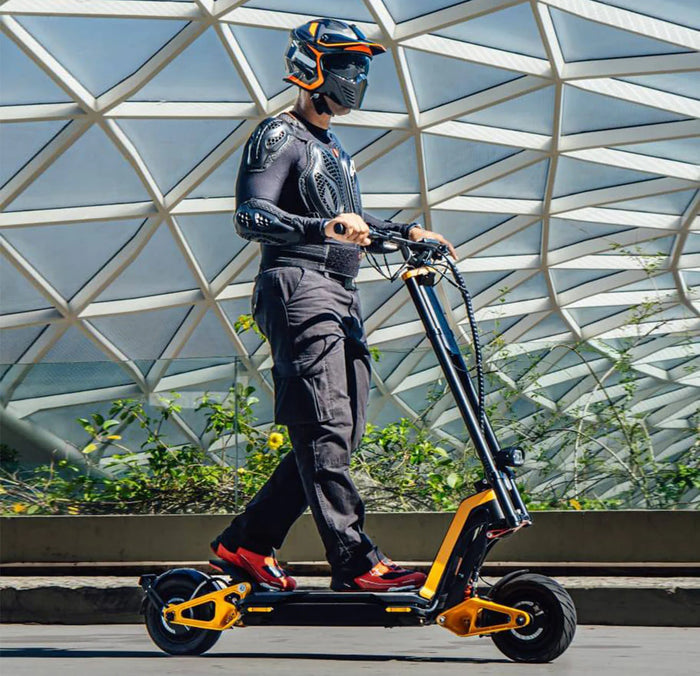
The Short Verdict: Commuting Without Compromise
The Segway Max G3 solves the single greatest problem that haunted previous commuter generations: bone-shaking ride quality on fractured urban asphalt. By pairing an upgraded 850W peak brushless rear motor with front and rear hydraulic suspension and 11-inch self-healing tyres, Segway has turned the legendary tank-like durability of the Ninebot platform into a machine you can actually ride across Dublin every day without needing an appointment with a chiropractor.
Why the Segway Max Series Needed This Overhaul
Anyone who has commuted along the North Quays, dodged the sunken inspection covers on Camden Street, or crossed the granite sets around Trinity College knows that perfectly smooth tarmac remains one of Dublin's rarer urban luxuries. For five years, the original Segway Ninebot Max G30 and G2 earned an unshakeable reputation across Ireland for one reason: they simply refused to die. You could leave them out in a drizzle, ride them through winter road grit, and neglect them for months, and they would still power up every morning.
However, the early models were fundamentally rigid scooters. While reliable, the ride quality transmitted every micro-crack, rumble strip, and pothole rim directly through the deck, up your ankles, and straight into your spine. Riders who loved the electronics and battery longevity found themselves looking envious at heavy dual-motor performance scooters just to get plush suspension.
The Segway Max G3 directly addresses that gap. Instead of bolting on basic elastomer springs as an afterthought, Segway rebuilt the lower chassis around an active front hydraulic fork and rear hydraulic twin-shock architecture. The result is a premium commuter scooter that maintains the sealed, industrial reliability Segway is famous for, while delivering genuine ride comfort that matches our challenging Irish road surfaces.

The Segway Max G3 incorporates front hydraulic suspension and a reinforced frame built for all-weather commuting.
Motor Performance and Hill Climbing: 850W Peak Output
On paper, the Segway Max G3 delivers 450W nominal motor power with an instantaneous peak output of 850W sent directly to the rear wheel. In the workshop and out on Dublin roads, rear-wheel drive is the superior configuration for Irish riding. Front-wheel drive commuter scooters have an annoying habit of spinning out when accelerating over wet steel manhole covers or leaf-covered autumn cycle paths. With rear-wheel propulsion, the rider's weight pushes directly down into the driving tyre, providing continuous traction when you pull away from traffic lights.
What does 850W peak power feel like on real climbs? If you are taking the gentle gradient up Rathmines Road toward Dartry, the Max G3 holds speed without hesitation. On sharper ascents—such as the incline climbing up St Patrick's Hill or coming out of the Strawberry Beds towards Castleknock—a 78 kg rider will notice the scooter maintaining a steady 18–20 km/h rather than bogging down to a crawl. The motor controller uses updated field-oriented control (FOC) algorithms, meaning throttle delivery is progressive and smooth rather than jerky or unpredictable.
Segway Max G3: Verified Technical Specifications
| Specification Component | Manufacturer Rating | Lifty Workshop Assessment |
|---|---|---|
| Motor Output | 450W Nominal / 850W Peak | High-torque rear hub; excellent wet-surface traction |
| Battery Pack | 48V 551Wh High-Density Lithium | Smart BMS with dual thermal & short-circuit monitoring |
| Manufacturer Quoted Range | Up to 70 km (Eco mode, 15 km/h, 75kg) | Lab conditions on flat test track with zero wind |
| Realistic Irish Range | 42 – 55 km | Tested across Dublin city with stops, headwind & rain |
| Suspension Architecture | Front & Rear Hydraulic Damper Setup | Dampens potholes and paving vibration effectively |
| Tyre Size & Technology | 11-inch Tubeless with Jelly Sealant | Self-seals minor punctures up to 4mm diameter |
| Braking System | Front Drum + Rear Regenerative Electronic | Low maintenance; sealed against rain and road grit |
| Water Ingress Rating | IPX5 Chassis / IPX7 Battery & Motor | High weather resistance; avoid deep standing puddles |
| Net Vehicle Weight | 24.3 kg | Substantial road presence; heavier for carrying upstairs |
| Maximum Payload | 120 kg | Reinforced folding mechanism and tubular stem |
Real-World Range: Laboratory Claims vs Dublin Reality
Let's talk frankly about range claims. Segway's official promotional literature lists the Max G3 as capable of up to 70 km on a single charge. As anyone with basic physics knowledge understands, manufacturer range tests are conducted in climate-controlled indoor tracks at an unvarying 15 km/h with an ultralight test dummy, zero headwinds, and tyres inflated to maximum rock-hard pressure.
In the real world of Irish commuting, you are carrying a work backpack, riding into a gusting 25 km/h south-westerly wind across the East Link Toll Bridge, stopping and starting at 14 sets of traffic lights between Clontarf and Grand Canal Dock, and riding in temperatures that hover around 6°C to 11°C for six months of the year.
Under these authentic Irish conditions with a typical 80 kg rider maintaining a brisk commute:
- Full Commute Speed (20–25 km/h): Expect a dependable 42 to 48 kilometres of true operational range before reaching low-battery throttle throttling.
- Mixed Urban Riding (Drive Mode ~20 km/h): You can comfortably achieve 48 to 55 kilometres on a full charge.
- Winter Temperature Effect: During frosty December mornings (< 4°C), lithium-ion cell chemistry experiences internal resistance. Expect range to drop roughly 12–15% on very cold days, which is standard for every electric vehicle.
The critical takeaway is that even in worst-case weather, the 551Wh battery easily covers a round-trip commute from Swords or Dun Laoghaire into Dublin City Centre with plenty of safety margin to spare.

Clean cockpit layout with integrated turn indicators, high-contrast LED display, and sealed thumb throttle.
11-Inch Self-Healing Tyres: The Cure for Commuter Punctures
In our Dublin scooter repair workshop on Capel Street, tyre punctures represent over 60% of all customer walk-in enquiries. Most budget electric scooters ride on 8.5-inch or 10-inch wheels with thin inner tubes. When you hit a sharp granite chip or pinch the tube against a kerb edge under-inflated, you are immediately stranded.
The Max G3 steps up to 11-inch tubeless pneumatic tyres with an integrated inner layer of self-healing memory silicone gel. If you roll over a 3mm roofing nail or a piece of glass in the cycle lane, the centrifugal motion and tyre internal air pressure force the jelly sealant directly into the puncture channel, sealing the leak instantly without pressure loss.
Furthermore, moving from a 10-inch to an 11-inch diameter wheel significantly alters the angle of attack when striking road defects. Instead of slamming squarely into the edge of a road seam, the larger circumference rolls smoothly over the obstruction, reducing shock loads transferred to the folding stem and wheel bearings.
Need Electric Scooter Service in Dublin?
Whether you need tyre sealant checks, brake adjustments, or diagnostics on your Segway, Lifty Labs provides direct in-person workshop servicing right in Dublin City Centre. Repairs are handled strictly via customer drop-off at our dedicated workshop—no booking courier delays or postal transit.
BOOK DUBLIN WORKSHOP DROP-OFF →Irish Road Legality and Speed Configurations
Ireland's updated micromobility legislation (Road Traffic and Roads Act and S.I. 199/2024 regulations) defines strict operational boundaries for electric scooters on public roads:
- Maximum design speed of 20 km/h on public infrastructure and cycle lanes.
- Maximum continuous rated power of 400W.
- Maximum unladen weight under 25 kg.
- Mandatory front and rear lighting, side reflectors, and dual independent braking systems.
- Riders must be 16 years of age or older; scooters are strictly prohibited on pedestrian footpaths and motorways.
The Segway Max G3 weighs 24.3 kg, placing it precisely under the statutory 25 kg vehicle limit. The scooter features factory firmware settings that can enforce standard 20 km/h and 25 km/h European commuter profiles, complete with integrated front and rear turn indicators built directly into the handlebar ends. For customers operating on private estates, agricultural land, or designated off-road circuits, a performance configuration is available; however, Lifty Electric strictly advises all riders to maintain legal speed profiles whenever travelling on Irish public thoroughfares.
Who Should Buy the Segway Max G3?
Buy It If:
- You want bulletproof daily reliability: You need a machine that starts every morning in wet Irish weather without fuss.
- Your daily commute is 8 to 25 km each way: The genuine 45+ km range means you only need to charge every two or three days.
- You want real comfort without hyperscooter bulk: The dual hydraulic dampers eliminate road vibration while keeping the scooter portable enough for ground-floor hallway or office storage.
- Punctures give you nightmares: The 11-inch self-healing tubeless tyres remove the #1 headache of daily urban scooting.
Look Elsewhere If:
- You must carry it up four flights of apartment stairs daily: At 24.3 kg, the Max G3 is substantial. If ultra-lightweight portability is your #1 priority, look at compact alternatives under 16 kg.
- You are looking for a dual-motor racing rocket: The G3 is an engineering masterpiece for commuting, but it is not built for high-torque dual-motor thrills. If that is what you want, explore dual-motor powerhouses like the KuKirin G2 Master.
Frequently Asked Questions: Segway Max G3 in Ireland
Is the Segway Max G3 waterproof in Irish rain?
The Segway Max G3 carries an IPX5 water-resistance rating for the overall chassis and frame, with the battery pack and motor enclosure sealed to an even higher IPX7 standard. It handles regular Irish drizzle, spray from cycle lanes, and damp roads without difficulty. However, "water resistant" is not the same as submarine-proof. You should never submerge the scooter in deep standing floods, ride through kerb-deep puddles, or power-wash the deck with a high-pressure hose.
How long does a full charge take from empty?
Using the standard built-in 3A internal charger, a full recharge from 0% to 100% takes approximately 5.5 to 6 hours. Because the charger transformer is built directly inside the deck, you only need to carry a lightweight "kettle-style" 3-pin power lead rather than a bulky charging brick.
Does the Segway Max G3 have built-in anti-theft security?
Yes. The Max G3 integrates directly with the Apple Find My network, allowing iPhone users to track the scooter's location in real-time. It also features an electronic motor lock passcode via the Segway app that immobilises the motor and emits an audible alarm if anyone tries to roll it away. For physical parking in Dublin, we still strongly recommend pairing this with a sold-secure D-lock through the structural frame.
Can the Max G3 be repaired locally in Dublin?
Yes. Lifty Electric carries genuine OEM Segway replacement components at our dedicated Lifty Labs workshop at 157 Capel Street, Dublin 1 (D01 F5P1). We support brake adjustments, tyre replacement, firmware configuration, and electrical diagnostics with direct in-person customer drop-off.
Explore Connected Guides & Fleet Options
Continue your research across our dedicated Irish micromobility knowledge hub: