The Core Rule: Match the Machine to Your Route, Not the Marketing
Most people buy the wrong electric scooter because they shop by top speed and laboratory range figures on a website. In Ireland, what actually matters are tyre volume, hydraulic suspension, realistic wet-weather ingress sealing, and local spare parts availability. There is no single "best" electric scooter; there is only the best scooter for your weight, your route, and whether you have to carry it up four flights of stairs every evening.
Why Generic "Top 10" Scooter Lists Lie to You
The internet is flooded with generic affiliate blog posts ranking scooters based on whichever brand pays the highest sales commission. These reviews are typically written by writers in sunny California who have never ridden through a horizontal January sleet shower on the Grand Canal cycle track, never struck a sunken manhole cover in the dark on Dame Street, and never had to replace a severed motor cable after road salt ate through a cheap wiring harness.
At Lifty Electric, our view is shaped by the hundreds of scooters that roll into our Dublin 1 workshop every month. We see exactly which stems wobble after 500 kilometres, which battery enclosures fill with condensation, which brakes fade under heavy loads, and which manufacturers actually supply spare parts when something breaks.
Below, we have organised the best electric scooters for Ireland in 2026 strictly by real-world commuter use cases.

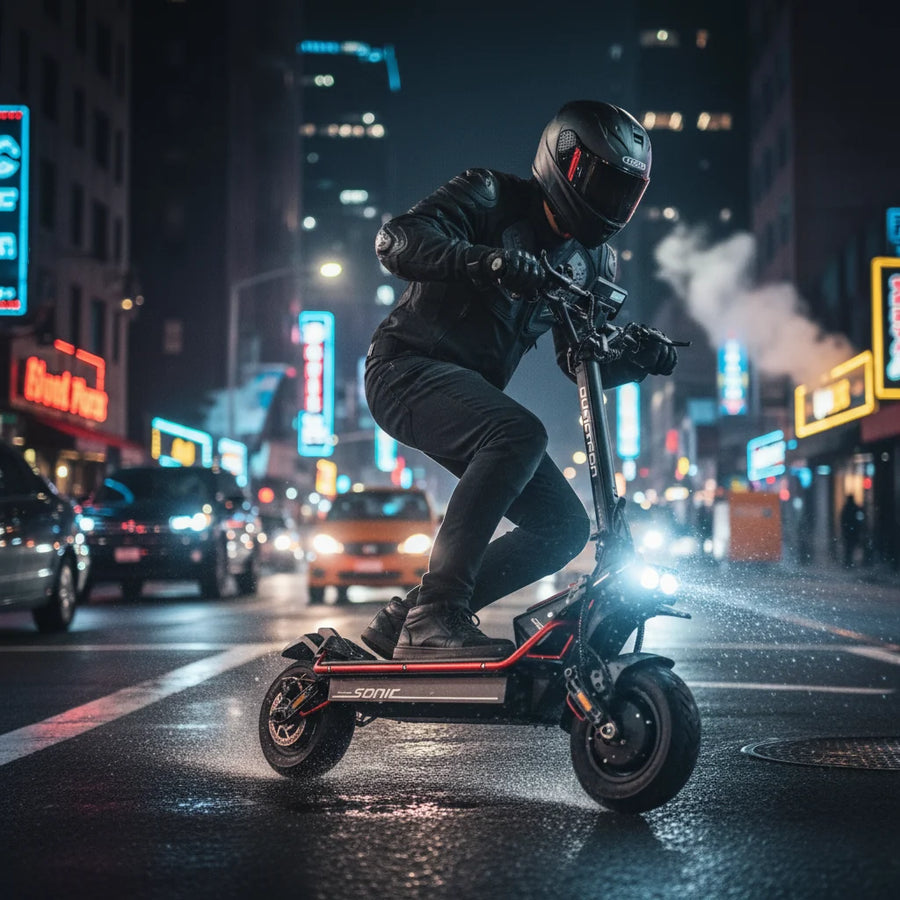
Commuting through Dublin requires durable tyres, proper suspension, and dependable wet-weather sealing.
Use Case 1: Best Premium Daily Commuter — Segway Max G3
The Benchmark: Segway Max G3
If your daily requirement is simple—you need a scooter that lives downstairs, gets unlocked at 7:30 AM every morning in all weather, and takes you 8 to 20 km into the city centre without drama—the Segway Max G3 is the undisputed champion.
- Why it wins: 11-inch self-healing tubeless tyres combined with front and rear hydraulic suspension completely cushion broken Irish road surfaces. The 850W peak rear motor climbs hills with zero bogging, and the sealed drum/electronic braking system requires almost zero ongoing maintenance.
- Real Tested Range: 42 to 55 km across Dublin in mixed conditions (compared to the 70 km laboratory rating).
- Ingress Rating: IPX5 chassis with an IPX7 sealed battery enclosure.
- Weight: 24.3 kg (solid road stability; manageable for ground-floor storage).
Use Case 2: Best Performance Dual-Motor Powerhouse — KuKirin G2 Master
The Dual-Motor Value Champion: KuKirin G2 Master
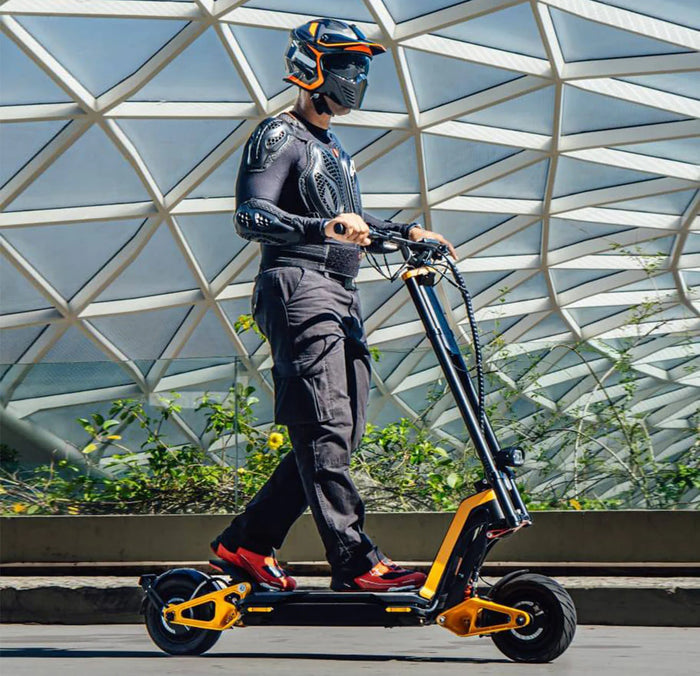
For riders seeking uncompromised dual-motor hill climbing, aggressive acceleration, and all-terrain suspension without spending thousands of euros, the KuKirin G2 Master delivers unprecedented performance in the under-€1,000 category.
- Why it wins: Dual 1,000W rated motors (2,600W combined peak) deliver 52 Nm of hill-climbing torque. Front and rear hydraulic shock absorbers cushion rough Irish asphalt and gravel, while 10-inch off-road pneumatic tyres provide exceptional grip.
- Power & Battery: 52V 20.8Ah (1,082Wh) high-capacity lithium battery providing 42 to 55 km of real-world endurance across Dublin.
- Weight & Chassis: 33 kg reinforced alloy frame with wide standing deck and integrated ambient visibility lighting.
Use Case 3: Best Lightweight Transit & Train Commuter — Ninebot E2 / E3 Series
The First & Last Mile Solution: Segway Ninebot E-Series
If your daily routine involves riding 2 km to the DART station, folding the scooter, carrying it up footbridge stairs, riding the train, and navigating a busy office building, a 25 kg scooter will quickly make you miserable. You need an ultralight vehicle that prioritises rapid folding, slim folded dimensions, and effortless one-handed portability.
- Why it wins: Weighing between 15.3 kg and 17.5 kg, the Ninebot E2 and E3 models are built for agility. Their hollow-core puncture-proof or tubeless tyres eliminate roadside flats, while their compact stem folds in two seconds.
- Real Tested Range: 18 to 28 km depending on battery capacity and rider weight.
- Irish Road Compliance: Factory configured to statutory 20 km/h limits with full lighting and front electronic plus rear mechanical braking.
Use Case 4: Best for Heavier Riders (95 kg to 120 kg) & Steep Inclines
One of the most frequent mistakes we witness in Dublin is a 100 kg rider purchasing a budget 250W commuter scooter with an 8.5-inch wheel platform. What happens?
- The small motor runs at 100% duty cycle continuously, causing the motor controller to overheat and cut out.
- The small tyres pinch against the rim under load, causing pinch-flat punctures every fortnight.
- On any incline greater than 4%, the scooter slows to walking speed, forcing the rider to kick-push.
If you weigh between 95 kg and 120 kg, you need two non-negotiable features: at least 48V to 52V electrical architecture (which delivers amperage without excessive heat) and a minimum tyre diameter of 10 to 11 inches. The Segway Max G3 (rated to 120 kg) and the KuKirin G2 Master are the premier choices in this category because their frames, bearings, and braking systems are engineered for substantial loads.
2026 Irish Electric Scooter Selection Matrix
| Category & Use Case | Top Lifty Recommendation | Ideal Rider Weight | Typical Daily Route |
|---|---|---|---|
| Premium All-Weather Commuter | Segway Max G3 | 65 – 115 kg | 8 to 25 km daily across Dublin streets |
| Dual-Motor Torque & Hills | KuKirin G2 Master | 70 – 120 kg | Steep inclines, mixed surfaces, heavy rider loads |
| Portable Multi-Modal (Train/DART) | Ninebot E2 / E3 Series | 55 – 90 kg | 2 to 5 km first/last mile transit connections |
| Heavier Commuters (100kg+) | Segway Max G3 / KuKirin G2 Master | 95 – 120 kg | Suburban commutes with incline challenges |
| Maximum Workshop Support | Segway / KuKirin Platforms | Any weight | Riders who want fast Capel Street parts turnaround |
Irish Weather: What IP Ratings Actually Mean in Dublin Rain
We cannot overstate this: water resistance is not waterproofing. No consumer electric scooter is completely impervious to water ingress if you treat it like a jet ski.
When evaluating scooters for Irish rain, look for these specific ratings:
- IPX4: Basic splash resistance. Fine for dry roads with occasional damp patches, but vulnerable to continuous Dublin winter downpours.
- IPX5: Sustained water jet resistance. Safe for riding through moderate rain, road spray from cycle lanes, and damp surfaces. Found on quality commuters like the Max G3.
- IPX7: Submersion resistance up to 1 metre for 30 minutes. Typically reserved for the internal sealed battery housing and motor core.
Regardless of IP rating, you should never ride through puddles deep enough to submerge the wheel hubs, never store an electric scooter outdoors uncovered overnight, and always dry the deck and charging port flap after riding in heavy rain. For riders seeking maximum all-weather longevity, our Dublin workshop offers specialised IPX6 weatherproofing upgrades with conformal PCB coating and automotive-grade silicone gasket seals.
Why Local Dublin Workshop Support Matters
Electric scooters are mechanical machines that require scheduled maintenance: brake pad replacements, tyre pressure checks, bearing inspections, and electrical diagnostics. Buying online from unverified overseas drop-shippers often leaves you with an unrepairable paperweight when a minor part fails. At Lifty Labs, we stock genuine parts and service our vehicles directly at 157 Capel Street, Dublin 1 (D01 F5P1) — strictly via direct customer drop-off.
BOOK DUBLIN WORKSHOP DROP-OFF →Understanding Irish E-Scooter Law in 2026
Before ordering any scooter in Ireland, make sure you understand the legal framework governed by the Road Traffic and Roads Act and S.I. 199/2024:
- Speed Limit: Maximum 20 km/h on public roads and cycle lanes.
- Power Limit: Maximum continuous rated power of 400W.
- Weight Limit: Maximum unladen weight of 25 kg.
- Where You Can Ride: On public roads and dedicated cycle lanes. Riding on pedestrian footpaths is strictly prohibited and subject to on-the-spot Garda fines.
- Age & Helmets: Riders must be 16 or older. While helmets are not currently compulsory by statutory law, Lifty Electric strictly advises all riders to wear a certified bicycle or skate helmet at all times.
Frequently Asked Questions: Buying an Electric Scooter in Ireland
Are electric scooters eligible for the Irish Bike to Work Scheme?
No. Under Revenue Ireland rules, the Bike to Work Scheme strictly covers standard pedal bicycles (up to €1,250), qualifying pedelec electric bicycles (up to €1,500), and cargo bicycles (up to €3,000). Electric scooters, mopeds, and motorbikes are legally excluded from tax-free salary sacrifice schemes. Any retailer claiming electric scooters qualify for Revenue Bike to Work tax relief is providing incorrect advice.
Should I choose solid tyres or pneumatic tubeless tyres?
For Irish road conditions, tubeless pneumatic tyres with self-healing jelly sealant (like those on the Segway Max G3) are vastly superior. Solid rubber tyres cannot puncture, but they offer zero shock absorption, vibrate violently on Dublin's uneven asphalt, wear down wheel bearings prematurely, and have dramatically reduced grip on wet road markings.
How often should an electric scooter be serviced?
We recommend an initial check-up after the first 300 km to verify bolt torque and brake cable bedding, followed by a comprehensive workshop safety service every 1,000 km or 6 to 12 months. Regular maintenance includes tyre pressure checks (aim for 45–50 PSI), brake pad inspection, folding clamp adjustment, and battery diagnostic monitoring.
Can I test or inspect these scooters in person?
You can visit our showroom at 157 Capel Street, Dublin 1 (D01 F5P1) to inspect build quality, handle weights, and speak with our technicians. For technical enquiries, you can also contact us via email at hello@lifty.co.
Next Steps in Your Micromobility Journey
Explore our in-depth model reviews and workshop resources: