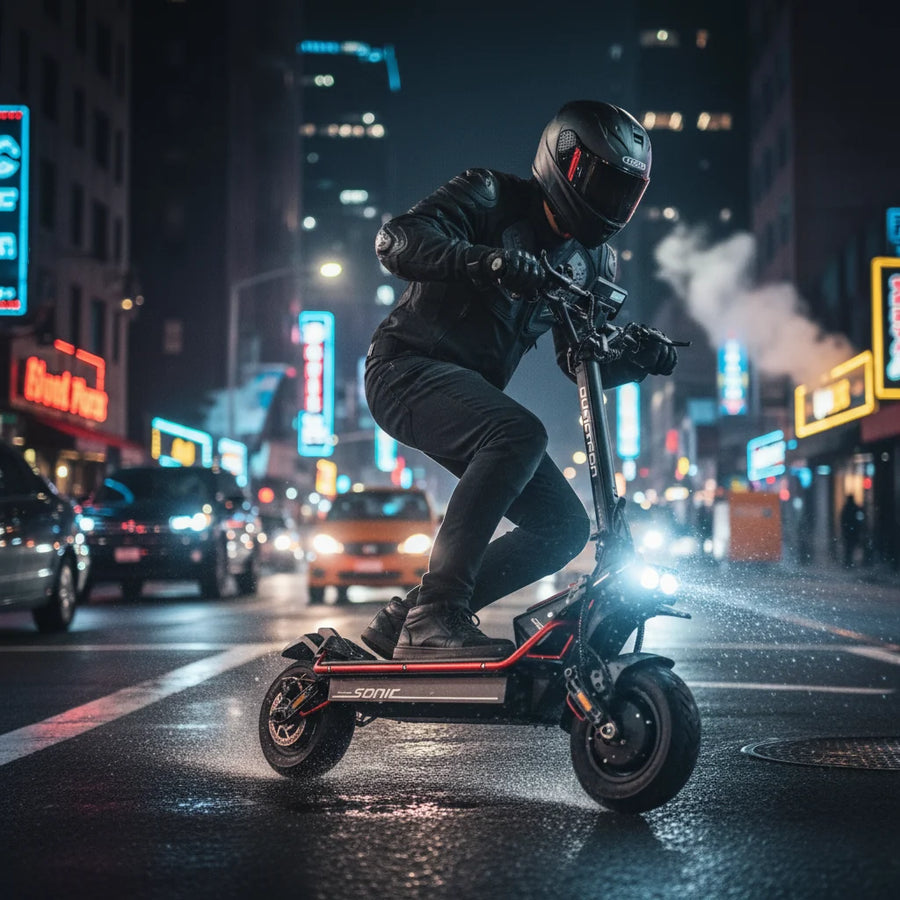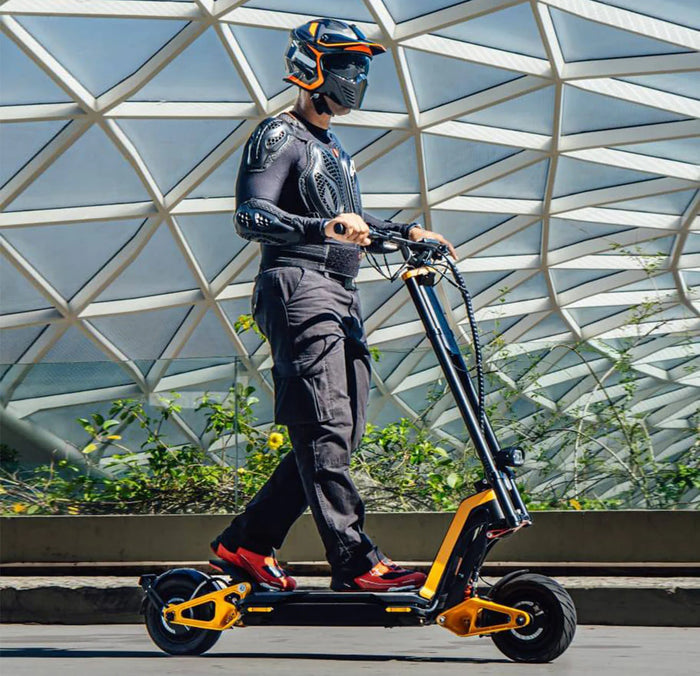
Dualtron Thunder 3 Review 2026: Is the Legend Still Worth Buying?
A real-world breakdown of living with a 72V, 113-lb hyperscooter: verified specs, braking demands, suspension realities, and who it actually makes sense for.

There are electric scooters, there are performance electric scooters, and then there is the Dualtron Thunder family.
For years, the Thunder name has been one of the machines riders eventually discover when an ordinary commuter scooter stops being enough.
More motor. More battery. More suspension. More tyre. More everything.
But that creates a fair question in 2026.
Is the Dualtron Thunder III still worth buying when newer rivals from Teverun, Rovoron and others are arriving with enormous batteries, sophisticated electronics and increasingly serious suspension?
The short answer is that the Thunder III still makes sense for the rider who specifically wants a large, established performance platform and understands what comes with owning one. But buying a Thunder because it has a frightening specification sheet is missing half the story. The interesting part is living with it.
Quick Answer: Is the Dualtron Thunder 3 Worth It?
For the right rider, yes.
The Thunder III is a large premium performance scooter intended for buyers who care about power, high-speed stability, substantial battery capacity, braking performance and a serious chassis more than portability. It is not the scooter we would recommend to somebody whose daily routine includes carrying it up three flights of stairs. Unless leg day is every day.
The more useful comparison is not: "Is the Thunder III powerful?" Of course it is. The real question is: Do you need a scooter in this category?
The Thunder Name Carries Expectations
Dualtron did not arrive yesterday. That matters in the performance-scooter world.
A specification sheet can tell you battery voltage and motor output. It cannot tell you:
- How mature a platform is
- How easy parts are to identify and source
- Whether an experienced owner community exists
- Whether workshops understand common maintenance needs
- Whether owners can keep the machine working long-term
That is one reason established performance platforms continue to attract buyers even when newer scooters arrive promising a bigger number for less money. With a machine this serious, ownership matters almost as much as acceleration.
Dualtron Thunder III Iberian Edition
Dual 2,500W rated motors (10,800W peak) paired with a massive 72V 40Ah (2,880 Wh) LG/Samsung battery pack and 4-piston hydraulic disc brakes.
*Manufacturer claim under closed-circuit test conditions.
View Product Details
Performance: Numbers Aren't the Entire Story
Nobody shops for a Thunder III because they are worried it might be a little slow. This is a high-performance dual-motor platform producing 10,800W of peak power through its twin hub motors.
But we would encourage buyers to stop obsessing over the final number on the speedometer. Acceleration delivery, throttle response, chassis stability, suspension behaviour, tyre condition and braking matter more to a satisfying performance scooter than winning an online top-speed argument.
And once speeds become extreme, poor maintenance becomes much more serious. A slightly worn brake pad on a small commuter scooter is a maintenance issue. On a 113-lb hyperscooter, ignoring brakes is a very different proposition.
That is why tyres, brakes, steering hardware and suspension condition should be treated as essential ownership items on machines in this category. For replacement parts and technical upkeep, explore our dedicated tyres and tubes collection and our workshop repair guide.
Range: Stop Believing One Magic Number
There is no single "real range." Range changes dynamically with:
- Rider weight
- Average cruising speed
- Acceleration frequency
- Gradient and hills
- Ambient temperature
- Tyre pressure
- Wind conditions
- Road surface resistance
A 160-lb (73 kg) rider cruising gently on level asphalt and a 250-lb (113 kg) rider repeatedly accelerating up a 15% grade are not conducting the same range test. The manufacturer rates the 2,880 Wh battery for up to 105 miles (170 km) under conservative eco riding. In real-world, mixed spirited riding, expect closer to 45–65 miles (72–105 km).
So when comparing the Thunder III with rivals, look beyond headline mileage. Look at battery watt-hours and then ask: How will I actually ride this machine?
Is the Thunder III Good for Heavier Riders?
Large performance scooters naturally attract bigger and taller riders because they generally provide:
- Larger, wider foot decks with integrated kickplates
- More substantial chassis components and reinforced swingarms
- Higher manufacturer load ratings (rated up to 265 lb / 120 kg official payload, with chassis design handling up to 330 lb / 150 kg)
But maximum rated load and ideal riding experience are not the same thing. A heavier rider increases demand on tyres, suspension, brakes, battery, motors, and steering components, and reduces real-world range.
Check the current manufacturer-rated load for the exact Thunder III configuration before purchasing, then leave a sensible margin rather than treating the maximum figure as a challenge.
Verified Technical Specifications
Scroll horizontally to view full specifications →| Component | Manufacturer Specification (Dualtron Thunder III) |
|---|---|
| Motors | Dual 2,500W rated motors (10,800W peak with Overtake mode) |
| Battery Pack | 72V 40Ah (2,880 Wh) LG/Samsung M50LT 21700 cells |
| Top Speed | 62 mph (100 km/h) (Manufacturer claim; private closed circuit only) |
| Estimated Range | Up to 105 miles (170 km) Eco / 45–65 miles (72–105 km) Real-World |
| Vehicle Weight | 112.9 lb (51.2 kg) |
| Braking System | 4-piston hydraulic disc brakes, 160mm ventilated rotors, electric ABS |
| Suspension | Modular rubber elastomer cartridges (front & rear), 5 replaceable hardness options |
| Tyres & Wheels | 11" x 3.5" (90/65-6.5) ultra-wide tubeless road tyres |
| Display & Cockpit | EY4 oversized waterproof display with Bluetooth App integration |
| Maximum Payload | 265 lb (120 kg) official rating / 330 lb (150 kg) structural threshold |
Suspension Matters More Than Acceleration Videos
One of the easiest mistakes in performance-scooter shopping is concentrating entirely on motor output. Then you ride it. Suddenly suspension becomes the only thing you care about.
At higher speeds, poor road surfaces expose chassis weaknesses instantly. A powerful scooter with badly tuned suspension can be far less enjoyable—and far less safe—than a slightly slower scooter that stays composed and communicates what the tyres are doing.
For American riders, this becomes especially relevant on cracked urban streets, frost heaves, potholes and uneven asphalt repairs. A pothole does not care how many watts your motors have. Dualtron's modular elastomer system allows swapping suspension cartridges between soft, medium and hard compounds, tailoring the damping to your exact weight and street conditions.
What About the Tyres?
Treat tyres as part of the performance system. Check:
- Tyre pressure (typically 45–50 PSI for 11-inch tubeless tyres)
- Tread depth and wear pattern
- Sidewall damage or embedded debris
- Valve stem integrity and non-return seals
Incorrect tyre pressure drastically alters handling, reduces range, degrades braking grip, and dramatically increases puncture risk. If you own a scooter capable of serious performance, buying a decent digital tyre-pressure gauge may be the cheapest and most important upgrade you ever make.
Braking Deserves More Attention
Customers naturally ask: "How fast is it?" The question we would like to hear more often is: "How well does it stop?"
A performance scooter needs braking hardware appropriate to its mass, speed and rider payload. The Thunder III features 4-piston hydraulic calipers clamping down on 160mm disc rotors. But even excellent hydraulic brakes require regular maintenance:
- Brake pads wear quickly under high-speed friction and require periodic inspection
- Rotors can glaze, warp or accumulate road grime
- Mineral oil hydraulic lines must be bled periodically to avoid spongy lever feel
Before any aggressive ride, ensure your brake levers engage firmly with predictable bite. If lever travel changes suddenly, stop riding and inspect the system immediately.
Is the Thunder III Portable?
We need to discuss the elephant in the elevator. Large performance scooters are technically foldable. That does not automatically make them portable.
There is a monumental difference between:
"The stem folds down."
and:
"I would happily carry this 113-lb machine up to my fourth-floor apartment twice a day."
Consider your storage environment honestly before purchasing:
- Do you have ground-floor or garage storage?
- Is your elevator deep enough to fit a 50-inch vehicle?
- Does your car trunk have enough width to load a 113-lb scooter?
- Do you have a secure indoor outlet for 7-hour charging cycles?
Dualtron Thunder III vs Teverun Fighter Eleven Plus
This is where things become interesting in 2026. Teverun's current Fighter Eleven Plus is targeting exactly the rider who historically would have automatically bought a Dualtron.
Teverun brings: Modern electronics, 4-piston hydraulic brakes, adjustable KKE coil suspension, built-in steering damper, GPS, and a large TFT cockpit.
Dualtron brings: Heritage, proven modular elastomer architecture, massive aftermarket parts support, and an established enthusiast ecosystem.
The right question is not which badge is better—it is which ownership philosophy matches your life.
Who Should Buy the Thunder III?
Consider the Dualtron Thunder III if you:
- Specifically want an established 72V hyper-performance platform with proven high-speed stability
- Value Dualtron's massive global parts catalog and community troubleshooting knowledge
- Have secure ground-level or garage storage with easy street access
- Prioritise sheer acceleration and road presence over lightweight portability
- Are prepared to maintain high-pressure tubeless tyres and hydraulic braking hardware
Who Probably Shouldn't?
Look elsewhere if:
- You need to carry your scooter up stairs or onto public transit regularly
- You are looking for a casual urban commuter under 50 lb
- You do not have a secure ground-floor storage space
- You do not want to perform routine mechanical checks on tyres, bolts, and brake pads
- You are buying purely because of a top-speed number on a forum
Frequently Asked Questions
Is the Dualtron Thunder III suitable for a beginner?
No. A 72V, 10,800W peak dual-motor hyperscooter weighing over 112 lb is not a suitable platform for someone without extensive electric-scooter riding experience. Its throttle responsiveness, mass, and high-speed momentum demand respect and motorcycle-grade protective gear.
How does the Thunder III perform on steep hills?
With dual 2,500W rated motors and massive low-end torque, the Thunder III climbs steep urban inclines (up to 35° / 70% gradients depending on rider payload and battery state) without noticeable speed decay.
Does rider weight significantly impact range?
Yes. Higher rider payloads require more energy to accelerate and maintain speed against aerodynamic drag and rolling resistance. A 220-lb rider will typically see 25–35% less range compared to a 150-lb rider cruising at the same speed.
What maintenance does the Thunder III require?
Owners must regularly check tyre pressure (weekly), monitor brake pad thickness, inspect hydraulic fluid levels, check steering clamp bolts for torque, and ensure elastomer cartridges remain in good condition.